

A Little Guide to Yūrei
It’s August. After weeks of unrelenting rain in June, the heat has now finally gotten unbearable. Despite that, you have decided to venture out on a walk, equipped with your sun umbrella and a portable fan. You walk around the neighbourhood and stop at 7-11 to get some papico. For your final stretch of the walk you decide to stroll past the temple, hoping its trees will provide some relief from the sun. You pass the temple, into a little road, which, while not shaded entirely, provides some relief. You are now next to the cemetery. You walk along the path lost in thought, when suddenly the rattling of wood wakes you up. You look onto the cemetery and find some 卒塔婆 sotoba are rattling in the breeze. Strange, you think to yourself, there wasn’t any wind before. And just then, you notice the eerie silence that has suddenly encompassed everything. Even the cicadas have stopped their tune. You should probably get out of there, you think to yourself, it is August after all.
The Season of Yūrei
It’s summer. Ice cream, sun and beaches, right ? Wrong. In Japan, it’s the season of Obon, the time when ancestors return to their homes. And there’s another thing, something colder, creepier and possibly dangerous.
According to some (but not all) Saijiki yūrei (ghost) is a 季語 kigo, a seasonal term used in haiku, for the summer season.
幽霊も鬱なるか
傘さして立つ
do ghosts get depressed, too?
standing under an umbrella
-山川蟬夫

Translation from longdream.wordpress.com
Similarly, “hyakumonogatari”, meaning as much as “a hundred ghost stories”, is also recorded as a word for the summer season. Telling one hundred ghost stories under the light of one hundred candles (or lamps) is supposed to summon spirits. One story and one candle each, as the room slowly gets darker.
So, summer means ghosts. This might be explained by everyone staying awake until late at night and telling ghost stories, or maybe it’s a way to cool down through the shivers they might give you.

Kitagawa Utamaro, Public domain, via Wikimedia Commons
This post is going to be about what ghosts actually tell us about Japan, so it’s more of a cultural focus, rather than an actual retelling of various ghost stories. If you are interested in the different types of yūrei, check out August’s yōkai of the month.

What is a Yūrei?
To fully understand what a ghost in Japan does or is, we first need to look at the idea of the afterlife in Japan.
Like so many things, it is infused with both indigenous Japanese ideas and Buddhist ones.
In Japanese buddhist tradition, it is thought that after death, a person’s soul gets separated from the body, wanders around for some time and then crosses the river Sanzu no kawa to become a buddha, a process called jōbutsu 成仏 in Japanese.

Wicked people, on the other hand, fall into hell and are punished by the Great King Enma. There’s also the idea that souls return to the mountains or go to Yomi, the Shintō land of the dead or to a paradise called Tokoyo. In summer, the deceased souls return to visit their homes, which is celebrated as Obon, reflecting an important part of Shintō: Ancestor worship.
If the soul has an attachment to the world, or worse, a grudge, they become ghosts, so-called yūrei (or borei).
These ghosts were actually first believed to be messengers of some sort, either announcing or demanding something. Only later did they become souls attached to the world due to various reasons, like an untimely death or unresolved issues.
To help them “Seibutsu shita” (attain Buddhahood) and move on, it is important to dissolve their attachments by fulfilling their wishes.
A similar concept exists in Shinto, because of course the belief in ghosts is older than the arrival of Buddhism in Japan, however ghost don’t turn into Buddhas (makes sense it’s not Buddhism after all), but are appeased. However, the lines between those two religions in Japan is quite blurry, so we don’t have to worry about the difference too much right now.
Buddhist funeral rites are also set up to make sure that the deceased person’s soul can easily pass Sanzu no kawa and prevent them from turning into ghosts. Contrarily, if someone is not buried properly, or according to their will, they might become ghosts, as well.
The literal meaning of the Kanji also gives us a hint about the nature of ghosts 幽霊.
幽 can mean: seclude, confine to a room, deep, profound, secluded, faint, dark, tranquil, calm.
霊 is translated as either spirits or soul. I don’t know about the exact etymology of the word, but the “secluded soul” would actually fit quite well. Ghosts are attached to the world, but they are secluded from the spirit world, confined to wander eternally, never moving on, never reaching the other side of the river. From a Buddhist perspective, they are confined, because they’ll never reach enlightenment (if not treated properly).
Yūrei in Edo
While the concept of ghosts existed in Japan way before the period referred to as the Edo period (1603-1868), ghost stories (and stories of yōkai for that matter), so-called kaidan (sometimes romanised as kwaidan, literally meaning ghost story), became quite popular during this time.
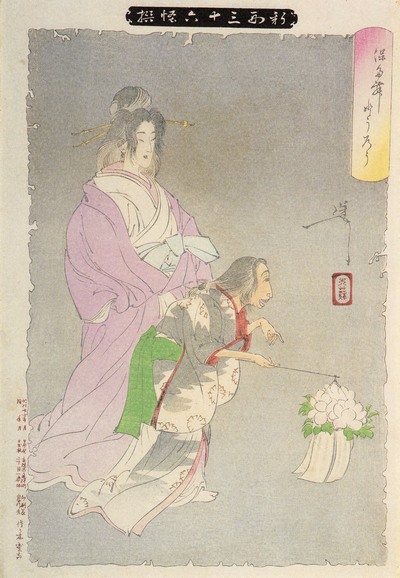
Famous and popular stories like 「雨月物語」Tales of Moonlight and Rain, 「牡丹燈籠」 The Peony Lantern and「四谷怪談」 Yotsuya Kaidan were all written during the Edo period. Here is a podcast episode from the Uncanny Japan Podcast retelling them:
Ghosts are heavily featured in Japanese media to this day, may it be in theatre, Kabuki, film, games etc. Usually these tales include “the same emotions of revenge, fury, obligation, and frustration (…)”, as Iwasaka and Toelken write.
Appearance of Ghosts
How?
How would you know if you’re seeing a ghost? How are ghosts usually portrayed? If you’ve seen movies like The Grudge, you might actually already have an idea, and it’s not too far off, at least for some ghosts.
In ancient accounts ghosts were usually portrayed in the exact same way they looked during their lifetime. Later, they were described as wearing white clothes, with a triangular forehead piece, a tenkan, which was representative of how they looked during their funeral.
We also have to talk about legs, because Japanese ghost don’t tend to have them, but that wasn’t always the case. Only in the 18th century did ghosts start to loose their legs (not literally), first they were thinning out, then they started being portrayed as having a fuzzy lower body. Who originated this is debated, some say it comes from the depictions of ghosts in woodblock prints (ukiyo-e) or from kabuki theatre.
“Matsugoro is considered the originator of ghost stories because he changed the traditional image of ghosts with legs to ghosts without legs. This idea came from the concept of a human soul, which leaves a long trail behind it […]”
Other than that they were often depicted with their elbows bent and their hands hanging down. A lot of the stereotypes of Japanese ghosts we see today came into existence during the mid to late Edo period. In the present day, there are also various stories of yūrei appearing, looking almost like a living person, with ordinary clothes, therefore being mistaken for ordinary people. So, apparently ghosts can have many forms.

When and Where?
Like in Western ideas of ghosts, yūrei are said to appear in cemeteries, but also under willow trees at the riverside, which might be due to the symbolism and quiet sadness willow trees evoke.
The hour of ghosts in Japan is a bit different from ours and mostly said to be around 2:00 a.m., during 丑三つ時 (ushimitsu-doki). I talk about this some more in this post: Why you shouldn’t visit Japanese shrines at night, so I won’t repeat myself.
Between Worlds
Boundaries and the in-between spaces of our world are very important in Japanese (ghost) stories. Consequently, it was believed that monsters often appeared at dawn, and in areas that signified some sort of “boundary” like a street on the outskirts of town or bridges. This might be related to the idea of different worlds existing basically parallel to each other and these spaces functioning as “bridges” to them.
“Konoyo, “this world here,” is the precinct of the living; anoyo, “the world over there, yonder” is clearly the other side, the long-term abode of the dead.”
The other world can be ”far away over the sea; […] past the mountains; […] beyond a great river; and in the Kajiki, it is described as being underground.”

The world beyond is “in almost all cases […] final”, however the spirit still has a connection with our world, caring about family welfare and luck. It can also remain in this world, or be called back, because the way to the other side can take quite some time.
As mentioned above, souls stay in this world due to “unfinished business, unfulfilled obligations, a need for vengeance, feelings of jealousy, the desire for proper burial or more ritual.”, such a soul “might appear in the form of a ghost, cemetery fires or other striking phenomena.”
But why do some ghosts appear and some don’t? Fujii Takanao, a Shinto priest and scholar, believes “when a person dies, their soul enters the world known to the gods, and after a long time, it becomes a lowly god, so it does not appear in this world. It is the same as the gods, who cannot be seen with the naked eye. […] It is not that they appear or do not appear in this world, but rather, since they have become gods, even if they appear in this world, they are simply invisible to human eyes.”
Similarly to how gods appear at certain times, there are times when ghosts appear “by the will of the gods […]”. He continues, “The reason for this is that it is a matter of the spirit world, which is beyond human understanding.”
“Even if one has deep feelings in one’s heart, unless the gods who govern the underworld grant permission, it is difficult for one to come to this world, and the gods do not easily grant such permission. The appearance of departed souls is a rare and precious thing.“
Obviously, there’s no way to determine if this is right in any matter or form, but I think it is interesting that someone thought about this issue and I can’t help but wonder what the logistics of that would be.
Stories of Ghosts
二百六十有余を数える大名の屋敷に怪談のない家はほとんどなく、大概は幽霊を持合せておりました
There were more than 260 daimyo residences, and almost all of them had ghost stories associated with them.
There are way too many stories about ghosts to count, including folktales, stories of people killed at war, ghosts of the sea, ghost ships, the list goes on.

But yūrei are not necessarily a thing of the past. “Konno notes that legends such as these are being told in Japan by people of all ages and in every walk of life: poets and prominent people as well as professionals, workers, and country folk. Yanagita would conclude, surely, that the Japanese have brought their traditions with them into the present.”
Urban legends are still told and ever evolving. One famous example are taxi drivers both in Tokyo and Tohoku that report about transporting ghostly passengers.
Kiyoshi Kanabishi and his seminar students of Tohoku Gakuin University actually researched this phenomena after the earthquake that hit Tohoku in 2011.
One story goes like this: After the disaster, a taxi driver picked up a woman in her 30s, wearing a midwinter coat, even though it was early summer. She boarded at the station and asked to be brought to an address in an area where the tsunami had hit and was destroyed by it. The driver asked to confirm this and she replied, “Am I dead?” and disappeared.

Another urban legend of strange passengers happens in Tokyo. This is how it is described by Iwasaka and Toelken:
“A Tokyo taxi driver picks up a young woman in front of a hospital late one night. She asks to be driven to Hamacho, and when he inquires further about the address, she gives detailed directions. When the driver approaches the right neighborhood, however, he looks into the mirror and sees that she is not there anymore. He thinks perhaps she has fallen asleep or become ill and slumped down in the seat, so he stops at a traffic signal and turns around to find that she has vanished. He feels the seat and finds it terribly cold (a sign that a ghost has been there). The light has changed, and the other drivers behind him start to blow their horns, so he drives on.
Soon he hears her voice again, and she now asks to be driven to Aoyama. Later she asks to be taken back to Hamacho, and when he arrives at the desired address, he can smell incense from a funeral, but she makes no further sound or appearance. The driver stops people who are leaving the house and describes what has happened to him. They explain to him that a young woman of their family died the previous day in that hospital, and that they have just finished the first part of her funeral. The family pays the taxi driver for his trouble, but he is still puzzled, for he wonders why the young woman wanted to go to Aoyama.”
✩₊˚.⋆☾⋆⁺₊✧ ☁︎。⋆✧ ✧˚₊‧⋆。˚ ✦₊
I find this tragic, but also endearing, instead of being shocked about having transported a ghost, the driver is simply wondering why she wanted to go to Aoyama. This is an attitude I often find in Japanese storytelling, the supernatural is not necessarily questioned and simply accepted.
In Japan, superstitions about ghosts and their revenge are still rather common.
For example, it is custom to visit the Tokyo gravesite of Oiwa-san from the story Yotsuya Kaidan before adapting her story in film or kabuki to prevent accidents or bad luck and certain stories are said to bring misfortune to those who tell them. This might not be the case for everyone, but in Japanese sources, I do often see the adding of -san (a polite way to refer to someone) to the names of ghosts, once again showing a reverence and respect for them, which I’ll get to below.

✩₊˚.⋆☾⋆⁺₊✧ ☁︎。⋆✧ ✧˚₊‧⋆。˚ ✦₊
“Other contemporary legends mentioned by Konno include a phantom car which drives around without a visible driver, ghosts seen on airplanes, ghosts of accidentally killed people appearing at railroad crossings in the years right after trains went into service, stories about haunted houses, accounts of deceased persons (especially soldiers during wartime) appearing to their families to bid farewell, ghosts solving mysteries for police (by indicating the location of a hidden grave, for example), children’s sighting of ghosts which cannot be seen by adults, and out-of-body experiences described as dreams and omens.”
✩₊˚.⋆☾⋆⁺₊✧ ☁︎。⋆✧ ✧˚₊‧⋆。˚ ✦₊
So, pretty much the same stories and tropes you can find in the West. However, there’s another aspect: “it is not enough simply to acknowledge that the Japanese may believe in ghosts; ghosts are thought to express certain dilemmas which require culturally acceptable solutions. It is the values represented by these problems and reflected in their resolutions that the legends dramatize.”

Ghosts and What They Mean
Responsibilty
“A spirit’s orderly transition is dependent on finishing a task or fulfilling a culturally valid obligation. Dramatically speaking, then, the legend character who is confronted by a ghost who needs help to resolve an unfinished task is cast in the role of an observer or witness to the existence of both worlds interacting, as well as a living testimony to the validity of the resolution.”
According to Iwasaka and Toelken the stories of ghosts tell us a lot about the idea of on in Japan, which they translate as “obligation” or “responsibility”. However, it is more complicated than that:
“On entails not only an awareness of having received a favor, but carries with it the absolute necessity to respond and repay.” A concept that is quite crucial in Japan, for example reflected in お-土産 o-miyage.
This encompasses many spheres: “the immediate family, in terms of filial piety to one’s own parents; in the “vertical” family of ancestors and descendants; in the social systems (village, occupational) which are modeled on the framework of the family; in the relationship to the emperor, father of the culture (who, incidentally, “wears” his on to his own ancestors and to the kami).”
Part of this responsibility is also to fulfill the wishes of the ghost that might appear, as part of the living. Maybe they want things to be done differently, like having more sutras read for them, or something more specific.
However, if there is any reason for wrath, like being treated wrongfully, insulted, injured or murdered, the ghost’s vengeance and grudge might befall not only the wrongdoer, but also their family, their clan, their village, or even the whole community or region. This might go on for an unspecified time, even for generations. Which seems pretty consequential, considering that Japan is a society with a collectivist outlook, which also has aspects of on.

So, legends “are powerful expressions of the obligations and niceties which the Japanese feel are incumbent upon themselves as they lead normal, acceptable lives within their culture.”
In a way the stories of ghosts help preserve and reinforce these ideas. This also explains why an innocent person might get involved with a ghost, in a way they are not innocent, because they belong to a “group of people whose obligation it is to celebrate the souls of the dead.”
Taboos
One of the things Japan influencers, or people who went to Japan for two weeks and now think they know everything, like to stress are all the things you shouldn’t do in Japan. Don’t eat while walking, don’t talk on your phone on the train etc. These are innocent little taboos, but there are so much more and some of them are very subtle, probably too subtle for anyone to notice if not explicitly told by a Japanese person.
A visitor might not realise that they don’t see someone pass food from one chopstick to another or, god forbid, chopsticks standing upright in a bowl. Or the avoidance of the number four, for example when it comes to the colours of sushi or hotel rooms. There are many more examples of this.
Iwasaka and Toelken write these things “form the silent, understood matrix of everyday assumptions.”, they “underlie the gestures we see in the legends and in prints, plays,films, and literature.” and they carry “a tremendous symbolic load.”
A lot of these taboos are related to rituals done during a funeral, chopsticks stuck upright in a bowl are reminiscent of them, as much as passing food from one chopstick to another, same goes for the idea that it is unlucky to lie with your head north while sleeping. The number four is sometimes avoided due to it sounding similar to the word for dying. “An action, however symbolic, may actually bring about the reality it represents.”, so you better be careful.
Sentences and Words
These superstitions also exist for whole words or phrases. Iwasaka and Toelken mention examples like: not serving someone three slices “because mikire, “three slices,” also means “to cut the body.””, not writing four pages, because that would be shimai, which can also mean “final end”. The list goes on.
✩₊˚.⋆☾⋆⁺₊✧ ☁︎。⋆✧ ✧˚₊‧⋆。˚ ✦₊
The power of these superstitions and legends lies, according to Iwasaka and Toelken “in the ambiguity of interwoven worlds; there is little or no demarcation between the worlds of the living and the dead, family obligations do not cease with death, living humans may meet ghosts anytime, and people may see visions which only later are understood to have a meaning.”
They describe that “The fields of illusion and reality overlap and interact, and may indeed not be distinguishable”. It can lead to an “ambiguity and simultaneity which can thrive on anxiety and guilt, which can produce delicious ironies, and which can create the most stunning of tragedies.”

Stories of yūrei (well, I guess mostly onryō) juxtapose an individual, passionate ghost with “selfish” desires against the community and “the cultural need for harmony, ritual, order, cooperation, and conformity.” In the end, the community wins and can finally be at peace. If they don’t do the required actions however, they and the whole area will continue to be haunted. In this way the people are reminded of “their unresolved debts and obligations […].” Simultaneously “human emotions […] can be dramatized and perceived vicariously through a ghost character who represents […] the otherwise abstract and possibly embarrassing emotion which would normally be too volatile to express in personal interaction.”
Conclusion
As mentioned above, there are many stories of yūrei. I want to get into some of them a bit more in the future, so if you expected me to tell you ghost stories in this post, I hope you’re not disappointed and can wait. In the meantime, if you know some Japanese, this show is all about telling ghost stories, however it is not really looked at critically and really just that:
A podcast I like about ghost stories, also in Japanese:
I’d also recommend Uncanny Japan. It’s not all about ghost stories, but about Japanese folklore and their background in general and it’s in English!
There is also the Kowabana podcast, where stories from the internet are read, but from the ones I’ve heard, these stories often don’t seem like Japanese ghost stories and more so as stories set in Japan, I don’t know how to properly explain.
Overall, yūrei, like so many things in Japan, reflect Japan’s history and attitudes and how different ideas come together to form new things. At the end of the day it is difficult to say how many people actually believe in ghosts, but the taboos related to rituals surrounding death and superstitions with numbers etc. definitely make ghosts seem like a bigger part of daily life. At least culturally, it feels like they aren’t far away at all.
To end, I want to leave you with another quote from “Death Customs in Contemporary Japan”, because I don’t think I can say it any better:
“Japanese legends are powerful and enduring because they are a concrete articulation of important and deep abstract values; like poetry, they make feelings and ideas palpable.”
.₊˚.✦₊૮₍ ´• ˕ • ₎ა ♡‧₊˚ ✩‧₊˚ ✧˚₊‧₊˚ ૮꒰˶ᵔ ᵕ ᵔ˶꒱ა ✩₊˚.
Sources
Iwasaka, Michiko, and Barre Toelken. “Death Customs in Contemporary Japan.” Ghosts And The Japanese: Cultural Experience in Japanese Death Legends, University Press of Colorado, 1994, pp. 13–42. JSTOR, https://doi.org/10.2307/j.ctt46nrwv.6. Accessed 25 July 2025.
https://gendaihaiku.blogspot.com/2011/05/12.html
Comments


