

Lucky Bath Bombs or some Japanese Lucky Charms
If there’s one thing that is helpful about living in Japan and writing about Japan it’s that ideas come from all sorts of different places and sometimes very suddenly.
So, I wanted to write about this little thing I found at the Ikebukuro Loft. A little thing that is very fitting for this season, the New Year’s Season. Because of course these days everybody wants to make sure that the new year is filled with joy and most importantly: Luck.
In Japan, the New Year is related to a lot of customs, like drawing your fortune at a shrine, but that is a story for another day.
To achieve luck, there are a few beings you can ask or keep around you. In this case, they are hidden within a bath bomb, as little toys, because why not? These little luck-bringers are by no means limited to the time around the beginning of the new year, though, so you might come across them on different occasions.

So, let’s go on a little journey across Japan and its belief systems to find what might bring you luck in this new year. And, even though it is delayed: 明けましておめでとうございます!

1. Maneki Neko 招き猫
One of the most famous symbols of good luck is probably the Maneki Neko. Literally translated it means ‘inviting (or beckoning) cat’. And it is supposed to do just that: Invite customers to shops of all sorts or attract money, depending on which hand the cat is holding up. The lucky cat is not exclusive to Japan and can be found in China, Taiwan and other countries as well. Because of this, it is not entirely clear where the lucky cat comes from. A Chinese saying goes (translated into Japanese):
猫が顔を洗う時耳を越せば、しばらくして客が来るだろう.
When a cat washes its face over its ears, customers will come soon.
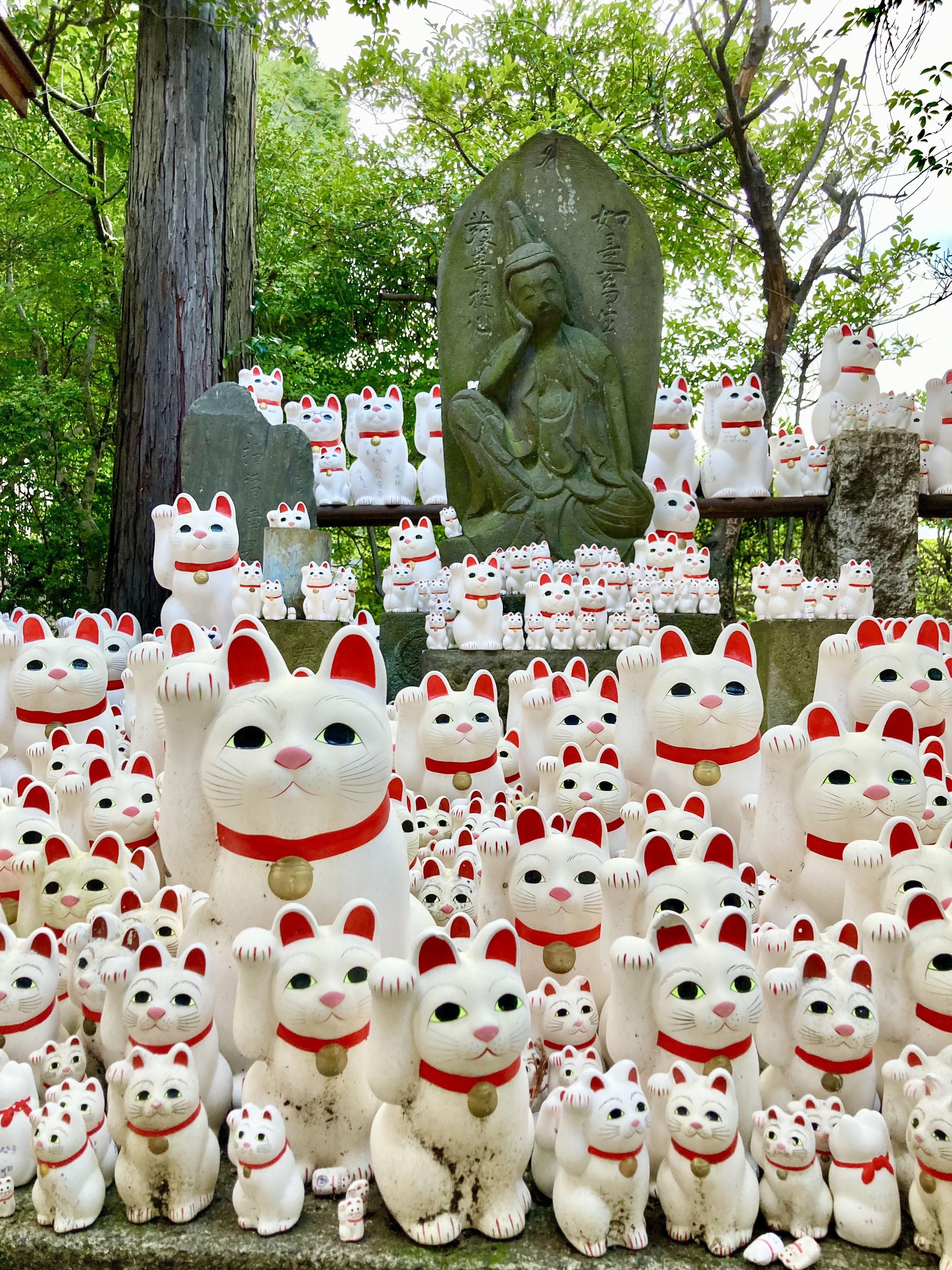
In Tokyo, two temples are associated with the Maneki Neko: The popular Senso-ji in Asakusa and Gotoku-ji in Setagaya.
The story of Gotoku-ji goes something like this: The temple was started by a poor monk, who always allowed cats to stay with him and shared his food with them. One day a nobleman, Naotaka Ii, was on the hunt when a grand thunderstorm arrived and he found shelter under a tree. From under the tree he saw a cat seemingly waving at him, inviting him to the nearby temple, Gotoku-ji. He decided to follow the cats beckoning and walked towards the temple, and as soon as he reached the temple’s gate, lightning struck the tree he had just been standing under, splitting it in half. Naotaka Ii was so thankful, that he not only became the temple’s patron, but that he also made it his ancestral temple. Within the grounds, a shrine for the cat Tama who saved him, Tama-shrine was built. When Tama, a statue of a beckoning cat was created to worship and honour him.
Gotoku-ji now sells Maneki Neko in all shapes and sizes and you can even take a small Maneki Neko train to get to the temple from Sangenjaya Station(三軒茶屋), it is definitely worth a trip, if you want to experience a quieter side of Tokyo.


In Asakusa, where Senso-ji is located, the story of how Maneki Neko statues got popular is a bit less dramatic and related to an old woman, who made a figurine to remember her deceased cat. The figurines got popular and the woman then got rich selling these statues.

2. Daruma 達磨
Daruma dolls are lucky charms depicting the Buddhist monk Bodhidharma, the founder of Zen Buddhism. The dolls are made out of paper-maché, but weighted in the bottom, so they’ll always stand up even if they fall down, representing the phrase: 七転び八起き (fall seven times, stand up eight). Therefore these round dolls signify resilience and overcoming misfortune.
A lot of these dolls are red in colour, because red is supposedly a strong repellent against misfortune and illness. The doll doesn’t have legs or arms (or eyelids) because Bodhidharma spent time meditating for nine years without moving, leading to his arms and legs to fall off. When he once nearly fell asleep during the meditation, he cut off his eyelids out of anger. The doll’s facial hair signifies longevity.
From this alone, you can probably gather why Daruma dolls are considered lucky. When you buy them both of their eyes are white, after deciding on a wish or goal you paint the left eye and place the doll somewhere where it can see you. Once the wish is fulfilled you’re supposed to paint the right eye.
At the end of the year, Daruma are burnt to honour them, in a celebration which is essentially a memorial service for them.

3. Inu Hariko 犬張子
Inu Hariko literally means paper mache dog. Hariko specifically is the technique used for making them. This technique is also used for other lucky charms on this list, like Daruma and Akabeko.
The figures are made by pasting paper on a frame made of bamboo, wood, or a mould made of clay. This technique is also used for making paper masks like those shown below.

The inspiration for the Inu Hariko most likely comes from the Komainu, which are the fierce looking guardians at the entrance of shrines, protecting them from evil spirits and bad luck. There’s usually two of them, one with an open and one with a closed mouth, representing end and beginning.

The tradition of using them as lucky charms (or they themselves) come from Atsuta Shrine in Nagoya, but they were also simply used as toys.
The dog is not only associated with the new year, but supposedly also protects babies and helps with delivery. This association probably dates back to earlier versions of protective dogs and dogs themselves being associated with safe delivery and good growth in babies.

The Metropolitan Museum, Public Domain
Inu Hariko are often used in a ceremony that can be translated as “first shrine visit”, which is a ceremony reporting to the Gods that the baby has safely reached the first month of their life. While some lucky figurines are supposed to be disposed of properly through dedication to a shrine, the Inu Hariko needs to stay with the baby to make sure it can protect them properly. However, Inu Hariko are supposedly lucky in general, so no worries if you’re not a one month-old baby.

4. Akabeko 赤べこ
The Akabeko is originally from Fukushima, specifically the Aizu region. It is one of the 会津張り子 and made from paper. The name comes from red (aka) and the local/Ainu word for cow (beko or peko). The colour red in general is seen as auspicious and warding off evil and illness, as mentioned above. Here too the story of the lucky cow is related to a temple. The legend says that cows helped built Enzo-ji, but a lot of them got tired from the harsh work and the only cow that worked tirelessly was a red one, which earned it a statue on the temple grounds.
The production of the red cow (and other figurines made from paper) was apparently started by the feudal lord of Aizu to help samurai make some money. He invited craftsmen from Kyoto to teach them the art of paper mache, and, inspired by the legend of Enzo-ji, they started making red toy cows. When there was an outbreak of smallpox in the area, children owning the red toy apparently didn’t get sick, which is why they are now associated with good luck and protection.
If you want to check out some more about Aizu and the Akabeko:
In the year 1961, which was the year of the ox in the Chinese calendar, the cow was featured on New Year’s stamps making it popular nation-wide.

5. Tanuki no Okimono 狸の置物
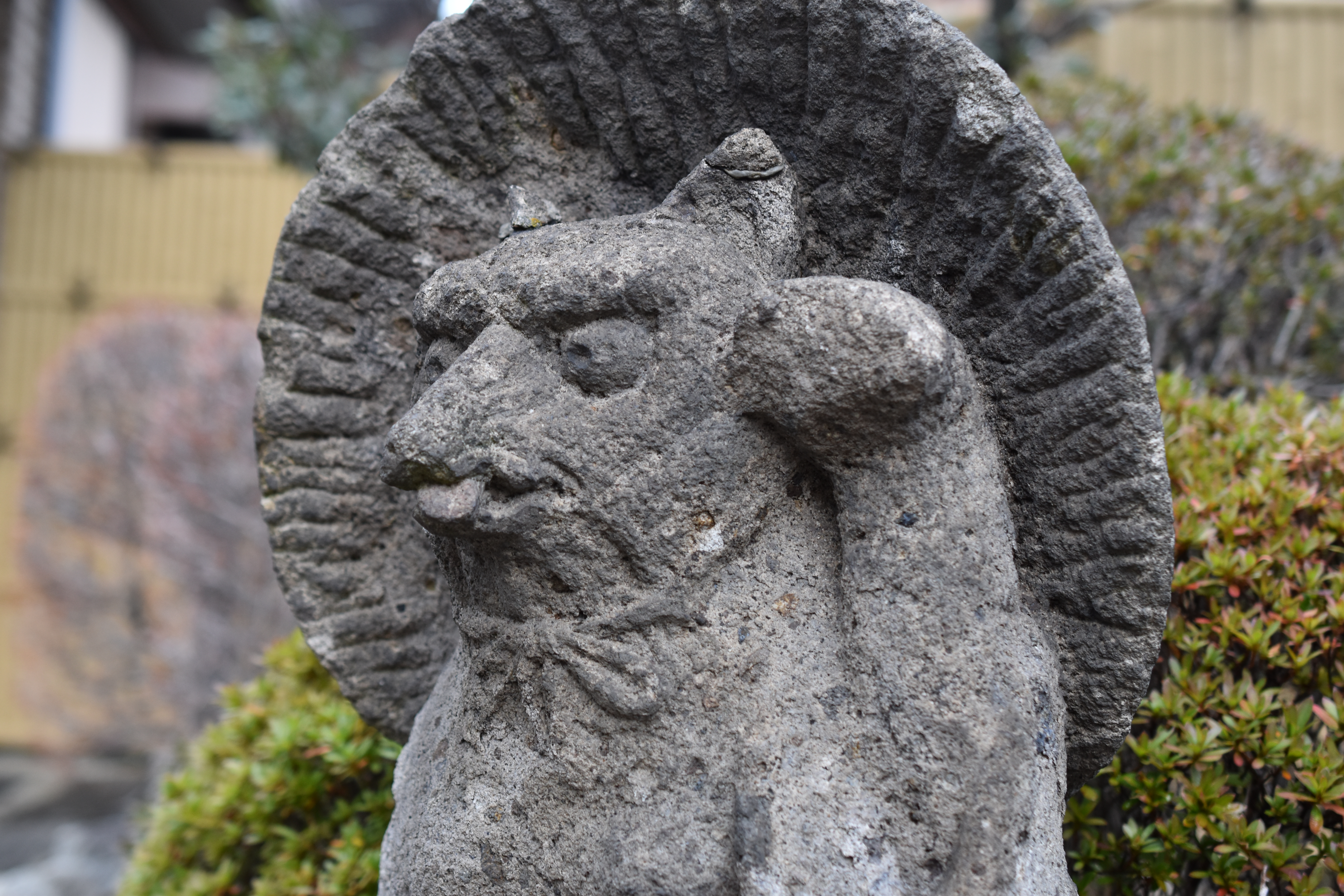
Tanuki no Okimono is probably the luck-bringer I see most often in my day-to-day life. Some are waiting in front of restaurants and shops, while others sit in front of someone’s door, on porches and driveways, others again live near places of worship. Stories of Tanuki are spread far and wide and they can be both very helpful and very mischievous. They have various powers, but their most famous one is transformation.
If you want to know more about another transforming animal (and one of the Tanuki’s enemies), check out my post on foxes.
Such Bake-danuki (transforming Tanuki) inspired the Tanuki no Okimono. Apparently the tradition of these statues comes originally from Kansai, specifically the Nada region.
Most of the statues are portrayed with 8 auspicious traits: a hat, a bottle of sake, a promissory note, a big belly, their eyes, their tail, their face and kintama.

Some of these attributes seem to come from a legend stating that sometimes Tanuki would show up to local breweries to get alcohol from them, carrying a flask and a promissory note.
Now onto the 8 traits:
- Hat: The racoon dog’s hat symbolises protection from trouble and being prepared for unexpected problems, as they protect the Tanuki from the rain, while they’re on their way to get alcohol.
- Eyes: The big, open (sometimes slightly uncanny) eyes represent awareness, good judgment, and being able to see the opportunities coming their way clearly.
- Face: The statues are usually portrayed with a smiling or generally friendly face, representing friendliness, kindness, and good relationships with others.
- Sake Flask: The sake bottle obviously stems from the tale, but it also stands for virtue and gratitude.
- Ledger The note or ledger represents trust, honesty, and luck in business dealings.
- Big belly: The Tanuki’s big belly represents good fortune, because the word can be read as “daifuku”, meaning, well, “good fortune” or “big luck.”
- Strong tail: If you look at the statues from behind you will find they have a thick tail, representing stability.
- Bag of Money or Balls: The bag of gold or money obviously stands for wealth, financial luck, and prosperity. This sack of money also has a different meaning: The (male) Tanuki also possesses kintama, literally meaning golden balls, but correctly translated they are simply just balls. In folklore, Tanuki are known for their, frankly, huge balls, which they can stretch and mold into all sorts of different things, including, but not limited to: household items, fishnets, drums etc. If you’re interested in that and want to see a few more depictions of tanuki-kintama shenanigans check out this post by hyakumonogatari. Now obviously, some interpretations of these 8 lucky traits might vary, this is simply what I’ve been told and researched about them.
The name Tanuki itself also has symbolism, because it sounds like ta-nuki (他抜き; “to surpass others”), because Tanuki are know for being able to face and defeat opponents that are stronger than them.
There are various forms of the statues, but the version you see above is the most popular one nowadays. This form was developed in the town Shigaraki by Fujiwara Tetsuzō.


So, these were some of the most popular luck-bringers of Japanese folklore and what they’re associated with. I like how these lucky beings come from all over, and even outside of, Japan.
I do think a lot of them deserve more attention and have way more stories, so I might come back to them sometime. Obviously there are other deities, creatures and charms associated with luck, but these are some of the more popular ones you might come across when you visit, or when you decide to buy bath bombs.
Map


.₊˚.✦₊૮₍ ´• ˕ • ₎ა ♡‧₊˚ ✩‧₊˚ ✧˚₊‧₊˚ ૮꒰˶ᵔ ᵕ ᵔ˶꒱ა ✩₊˚.
Comment
Sources
https://story.nakagawa-masashichi.jp/craft_post/121878
https://story.nakagawa-masashichi.jp/craft_post/120021
https://www.studio-alice.co.jp/shortcut/omiyamairi/column/detail59.html
https://www.ps-turtle.com/column/baby/48
https://aminaflyers.amina-co.jp/list/detail/1358


