

A Little Guide to Kitsune and Other Foxes (2)
“A black fox appears when a king by his government causes profound peace.” This is a sentence written in the 続日本紀 (Shoku Nihongi), an essential historical text from the 8th century. But don’t be mistaken. “Historical” in this context means it not only includes historical events, but also fictional and mythological ones. This sentence already gives us a little clue, fox doesn’t immediately mean fox. In the first part, I mostly talked about one specific type of fox, the “field fox” 野狐, however they are not the only foxes that roam Japan’s myths.

Why are there different types of foxes?
So, why are there different types of foxes? One reason for that is the never-ending complications of Buddhism and Shintō. They are technically two distinct belief systems with different stories and historical backgrounds. Shintō is Japan’s specific religion, whereas Buddhism is originally from India and arrived over China and Korea to Japan. On this journey things changed and were influenced and in Japan, Buddhism took its own Japanese form. To make things more complicated, even though Shintō and Buddhism are not the same, in daily life rituals from both religions play an important role and the borders are fluent.
You could say there are “good” and “bad” foxes, but as it usually happens with Japanese religion it’s not that simple. There are generally divine and “normal” foxes, with the normal ones raging from mildly mischievous to straight up destroying lives. And there’s also this thing about fox spirits…
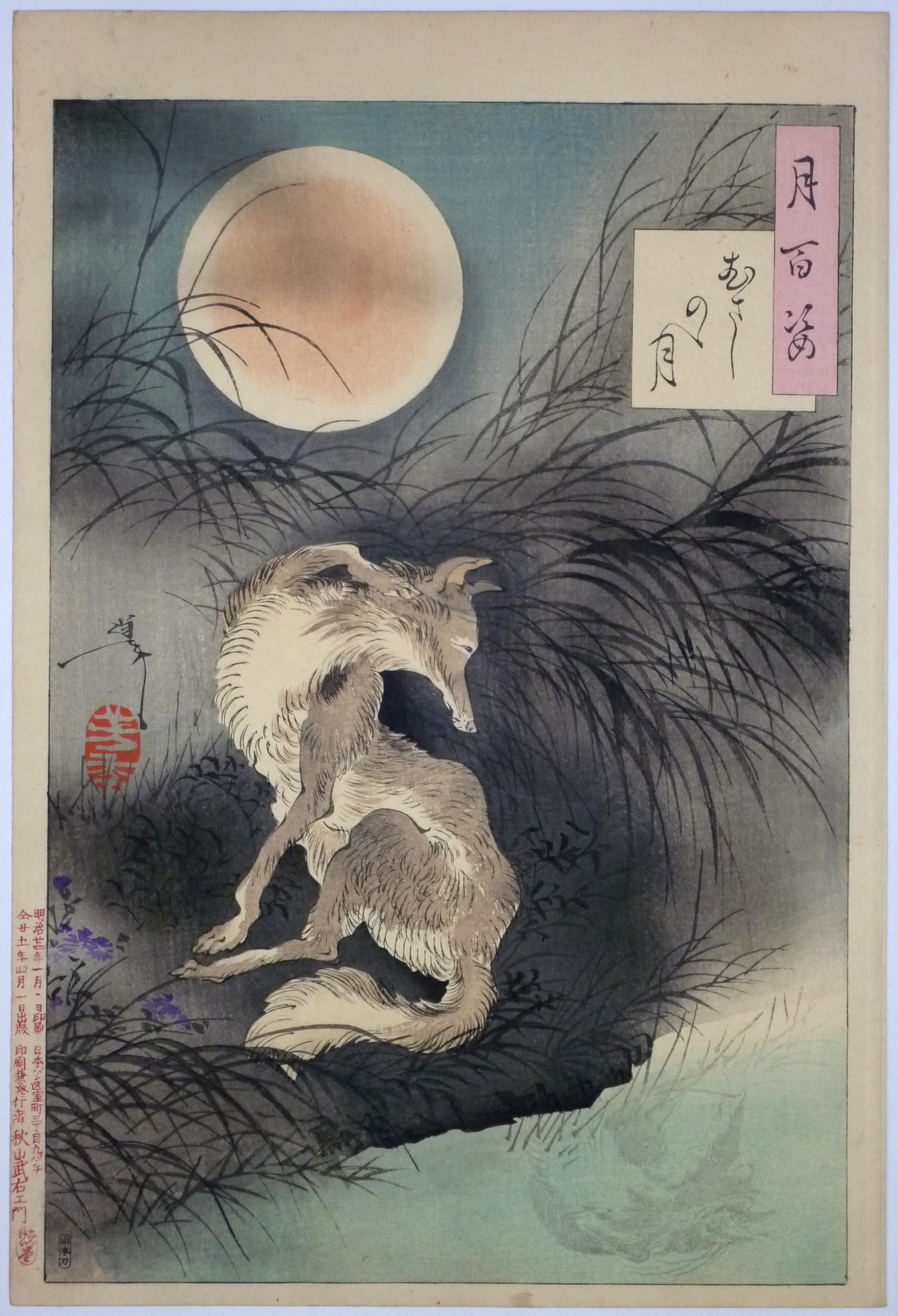
“Bad” Foxes, Yako 野狐 or Field Foxes
First, let’s talk about the “normal” foxes. Even though I wrote it in the heading, they are not exactly “bad”. A lot of stories regarding foxes doing bad things are actually related to people killing their kin or hurting them in some way, so, as revenge, a fox might trick or possess them, or cause a fire or two.
Some foxes might play tricks just because they can, like in the stories I mentioned in the first part. While it is not a nice thing to do, it’s definitely better than eating you, which Korean foxes apparently love to do, or stealing your life force to reach some sort of higher existence, like Chinese foxes ( even though Japanese foxes can spirit you away…so I guess neither is a “good” choice).
Generally, a kitsune is not a straight-up evil entity that only wants to do harm, they can also be grateful for help they received.
They act as a reminder to respect nature and to not go home to late, or marry someone you meet on a field at night. On a more serious note, it might also reflect a fear of outsiders, but I’m not a sociologist, so I’ll leave that here and move on.
However, stories of more evil foxes do exist (these might actually be more Chinese than native Japanese, because they are mostly associated with portraying the power of the Buddha).
Tamamo no Mae 玉藻前 and the Kuzunoha 葛の葉
One pair of foxes that portrays this nicely is the “bad fox” Tamamo no Mae 玉藻前 and the “good fox” Kuzunoha 葛の葉 . Tamamo no Mae is THE example of a fox hidden as a woman, causing havoc everywhere she goes. Kuzunoha, Abe no Seimei’s mother, on the other hand, is virtuous and kind.

日本語: 山川秀峰(明治31年-昭和19年)English: Yamakawa Shūhō(1898-1944), Public domain, via Wikimedia Commons
Tamamo no Mae, on her side of things, supposedly caused a lot of governments to fall, from India to China and finally to Japan.
“There is a king called Pan-Tsu in the remote western region of ancient India. His consort named Hua-yang, is, in reality, a white fox with nine tails. She is wicked and cruel by nature. She takes pleasure in seeing a thousand innocent people killed. “Later she flees to China when her true colors are disclosed. In China, calling herself Pao-ssu, she joins the harem of Yu, a king of the Chou dynasty. “She finally becomes the queen, still heartless and cruel. She rarely smiles unless she sees some cruel deed done. The king wants to see her smile, and therefore he does everything cruel to please her. The king and his kingdom cease to exist because of Pao-ssu, the nine-tailed fox. “After her death, Pao-ssu is born in Japan in the 12th century. It is the reign of the 76th Emperor Konoye (according to another legend, the reign of the Emperor Toba the 74th Emperor). ..” (Quoted from “Far-eastern” Fox Lore by T.W. Johnson).
After causing chaos in Japan, she was finally discovered by Kuzunoha’s grandson and chased to the north of Japan, where she turned into a stone. This stone is now called the “Killing Stone”, due to the fact that anyone who touches it supposedly dies.

Toriyama Sekien (鳥山石燕, Japanese), Public domain, via Wikimedia Commons
Thersa Matsuura did a whole episode on the Killing Stone. It is a great listen and podcast in general, so please do check it out:

✩₊˚.⋆☾⋆⁺₊✧ ☁︎。⋆✧ ✧˚₊‧⋆。˚ ✦₊
おさん狐 Osan kitsune
Another bad, or not so bad (?), fox is おさん狐 Osan kitsune from Western Japan. She transforms into a beautiful woman to seduce married men or those with lovers. She’s often portrayed as jealous and fond of stirring up love quarrels.
The term “女狐 (megitsune)” refers to such deceitful, female foxes.
In Osaka, Tottori and parts of Hiroshima she is described as vengeful and full of tricks. For example, she scared people by setting her tail on fire or turning herself into lions. (More than one?!) When a man captured and tried to burn her, she started to beg for forgiveness and promised to disguise herself as a daimyō’s procession the next night. (A daimyō is a Japanese feudal lord). The next night, a real daimyō’s procession appeared. The man was impressed and approached it to praise the fox for her great disguise. The very real and very much not a fox daimyō then had him beheaded for insulting nobility.
In Eba (Hiroshima City), she was seen as a noble fox, being the mother of 500 foxes. After WWII, locals reportedly fed her descendants. Even today, there’s a small shrine dedicated to her.
This sort of paradoxical behaviour could simply be explained by the name referring to more than one fox, or maybe Osan just had her favourites, who knows. Which now brings us to “good” foxes.
Good Foxes Zenko 善狐

While I mentioned before that “bad” foxes don’t really exist, because they are usually more complicated than that, “good” foxes certainly do.
These so-called Zenko can be divided into groups based on the colour of their fur and their spiritual achievement: 金こ kinko (gold foxes), ぎんこ ginko (silver foxes), byakko (white foxes), and kokuko (black foxes).
The spiritual rank ranges from entry-level foxes that are younger than 100 years to messengers of Gods (mostly Inari, more on them later), 気狐 Kiko to the one and only 天狐, or nine-tailed fox.
Divine Foxes 天狐 or 九尾の狐 The Nine-Tailed Fox
This is were we get into the complicated. Because a divine fox like a Tenko is also a Zenko, but not every Zenko is also a Tenko. so, how does a fox become a tenko? The first method would be to turn incredibly old.
A fox, after having lived for a thousand years (and gaining nine tails in the process), goes to heaven.
Loosely translated quote (from Japanese Wikipedia, shame on me): It is stated that the fox would learn the art of transformation at the age of 50, become a beautiful woman at the age of 100, and that he then would mislead people. After the age of 1000, he would not attack people anymore and instead move to heaven.
So even a bad fox can be transformed.
Which kind of makes me wonder, did Tama no Mae (and other bad nine tailed foxes) choose not to go to heaven? Or was that just never an option?
There’s also the second, arguably less comfortable option: To become a Tenko, the fox has to undergo intense spiritual training to become a Tensen (Heavenly Immortal).

Tenko are also beautiful. They are described as golden or white (nine-tailed) foxes, surrounded by some sort of aura. They exist in the Palace of the Sun and Moon (Nichigetsukyū) (which I gather is heaven?) and they also “comprehend yin and yang”, meaning they have deep understanding of the laws of nature and the world. Because of that, they are able to see thousands of miles into the future or distant lands.
Of all foxes/fox-spirits, Tenko are supposedly the highest ranking and looking at their powers it makes sense, I guess.
There’s also a Kūko, which is sometimes described as a “retired Tenko”.
Inari and Other Gods
As mentioned above foxes are heavily associated with one of the most popular Gods in Shintō: Inari Ōkami. If you’ve been to a shrine, I’m nearly certain you’ve been to an Inari shrine as well. They are the ones with the red gates lined up back to back and the ones with the fox statues (obviously).
There is so much lore there (again) that I decided to share stuff about Inari in a different post. This is supposed to be a little guide after all and not a book. To simplify: Inari is the God of prosperity, good harvests (and so, so much more). So, why foxes? One explanation might be because you can mainly see foxes during spring and autumn, important times for rice harvest.
On a side note, they also sometimes accompany the one and only Amaterasu and the Buddhist Goddess Daikini.

For the third Part, we’re going to focus on the different powers of a fox.
Part 3: Power of Foxes
Why are foxes so common in folklore and why are they called Kitsune in Japanese?

.₊˚.✦₊૮₍ ´• ˕ • ₎ა ♡‧₊˚ ✩‧₊˚ ✧˚₊‧₊˚ ૮꒰˶ᵔ ᵕ ᵔ˶꒱ა ✩₊˚.
Comment


