

August’s Yōkai of the Month: Yūrei 幽霊
It’s the season of ghosts, guys! Well, at least in Japan. While in European countries the spooky days are usually at the end of autumn and along the days of Christmas, in Japan it is in August. For one, telling creepy stories is a good way to cool down in the pressing heat of Japan’s summer. But there’s another aspect: August is the time of Obon. Obon is a festival where the souls of the deceased return to their homes and visit their families. While there are a lot of related customs, during this time Bon Odori (a dance) takes place.
So, you dance under the endless lanterns illuminating the night. Your face hidden, yukata swaying in the night. Here to join you are the souls of people long gone. And as you dance in circles the dead and the living reunite once more, even if it is only for a short while. Until the next August.


Because it’s the time of Obon, we’re going to start this little series with Japanese ghosts, or yūrei. I’ve actually made a full on separate post on them, as well, where I explore this topic and the cultural background a bit deeper. So, to avoid repeating myself, I will keep the general information very short.
✩₊˚.⋆☾⋆⁺₊✧ ☁︎。⋆✧ ✧˚₊‧⋆。˚ ✦₊
Japanese Death Customs
In Japan, when someone dies, their soul is separated from their body. Then, the soul needs to traverse a dangerous river to enter heaven and become a Buddha. This process is called 成仏 (jōbutsu).
The world of ghosts and the world of people is not as separate as we’d like to believe in Japan. Superstitions about death are still deeply embedded in everyday customs, a reflection of a certain reverence for the dead. And while I can’t tell you if Japanese people believe in ghosts more than other nations, it is not difficult to hear stories about haunted places all around the islands. Japanese ghosts are often featured in traditional theatre, portrayed with long, flowing hair, wearing a white kimono, in ukiyo-e they are sometimes portrayed wearing a triangle on their heads. And they tend to not have any feet. But maybe that’s a general ghost thing, what do I know?
This month’s yōkai of the month is going to be a general introduction to different types of ghosts. Some of these might be explored further later on, we’ll see.
This is also the first entry in my little monthly collection of creatures and ghosts, mostly the ones that are referred to in Japan as yōkai.

幽霊の種類 — Types of Yūrei
There are various types of yūrei, probably too many to count. You might notice that most of these ghosts feature the kanji (Chinese character) 霊, which simply means soul or spirit. So, usually it is Attribute+Spirit. Some of these terms are quite recent and were coined during Japan’s spiritual boom in the 20th century, but the concepts behind these terms are usually older.
The kanji 霊 can be read as both rei and ryō. When looking at the difference between reading the character “rei” refers to spirits that are visible, showing themselves, whereas “ryō” refers to spirits that are invisible.
Not all ghosts in Japan are necessarily scary or malevolent, some are even there to protect you. So, let’s start with those and get slowly to the more scary ones.
守護霊 (Shugo-rei) — Guardian Spirit

A Shugorei is a spiritual protector. They are usually attributed to being a deceased ancestor, but they can also be a non-human entity, a yokai, a deity or even originate from a previous life. Examples would be the zashiki warashi (a ghost child said to bring luck and protect the home they inhabit) or ship spirits.
As such, they fulfil a role similar to a guardian angel in Christianity: They might give guidance or provide protection, helping people through their life’s challenges one at a time.
✩₊˚.⋆☾⋆⁺₊✧ ☁︎。⋆✧ ✧˚₊‧⋆。˚ ✦₊
指導霊 (Shidō‑rei) — Guide Spirit
Shidōrei are spirits that help guide someone, as the name suggests. Interesting about them is the fact that they can be people similar to you: they may have pursued similar paths or interests in past lives and therefore feel inclined to lead you.
✩₊˚.⋆☾⋆⁺₊✧ ☁︎。⋆✧ ✧˚₊‧⋆。˚ ✦₊
背後霊 (Haigo-rei) — Spirit Behind You
A slightly more creepy spirit is “the spirit standing behind you.”
No, really. 背後霊 means the spirit behind your back.
背=back
後=behind
霊 = spirit
This term is used to refer to any spirit that’s currently attached to a person (Japanese ghosts love attaching themselves for some reason).
They might be ancestors, protectors, or even harmful spirits that cause misfortune or sickness.
Shidōrei are, like Shigorei, Haigorei: general spirits attached to you, so while the concept is a bit more scary, you might actually be thankful for their existence.
✩₊˚.⋆☾⋆⁺₊✧ ☁︎。⋆✧ ✧˚₊‧⋆。˚ ✦₊
祖霊 (So-rei) — Ancestral Spirit

Sorei are generally ancestral spirits. They are the ones venerated in household altars and during Obon. As such, they are the ones who visit their descendant’s homes every August.
Honestly, the first thing I had to think about when I read about them were the ancestors in Mulan. (Shame on me).
Their role is to watch over descendants to maintain good family karma and good fortune and customs regarding them are crucial to the religion of Shinto, which a lot of people argue was originally mostly about ancestor worship.
While one of them can become your personal Shugorei, they don’t necessarily have to be.
✩₊˚.⋆☾⋆⁺₊✧ ☁︎。⋆✧ ✧˚₊‧⋆。˚ ✦₊
自然霊 (Shizen-rei) — Nature Spirits

Nature spirits are, as the name suggests, the spirits of things existing in nature, like trees (they actually have specific spirits called Kurodama), stones etc. Nature spirits are attributed a spiritual rank, ranging from high-ranking spirits that are worshipped as gods to low-ranking nature spirits that may once in a while deceive humans and cause minor inconvenience.
Examples include the God Inari, the Dragon God Ryujin, and Tengu. Shizenrei are believed to have powers controlling natural phenomena like the weather. Dealing with them can be more difficult, as they aren’t humans and therefore naturally lack emotions, so they cannot be appealed to through compassion. This makes them quite dangerous.
✩₊˚.⋆☾⋆⁺₊✧ ☁︎。⋆✧ ✧˚₊‧⋆。˚ ✦₊
動物霊 (Dobutsu-rei) — Animal Spirits

Animal spirits refer to the souls and spirits of animals. In Shinto, most, if not all things can have souls, so, of course animals do, too. (Buddhism, too does not differentiate between animal and human souls.)
Animal spirits are often associated with forces of nature, like shizenrei, and they are often seen as responsible for possession. There are various types of possessions by animals, like fox possession, dog possession, and snake possession.
Nature in Shinto is sacred and personified. Animals are not necessarily just an animal, but rather an embodiment or vessel of spiritual power.
Some examples include the Shinto belief in foxes (kitsune) with spiritual power, (which I talk about in another post), the veneration of wolfs (written as ōkami, sounding very similar to ōgami, meaning great deity) or the etymology of orochi (giant serpent), which is often argued to come from mine no tamashii, or “spirit of the peak”, reflecting the idea that serpents or dragons dwell in mountains or rivers and embody their spiritual essence.
✩₊˚.⋆☾⋆⁺₊✧ ☁︎。⋆✧ ✧˚₊‧⋆。˚ ✦₊
浮遊霊 (Fuyū-rei) — Floating Spirits

Fuyūrei (浮遊霊) refers to spirits that don’t understand or accept their own death (or simply spirits that are floating around, separated from their physical bodies) that continue to wander the world of the living aimlessly without ascending to heaven 成仏 or achieving peace. This might happen if a person dies suddenly and doesn’t realise that they have died, or when they are unable to accept their death. Their defining trait is a state of spiritual disorientation or incompletion, often caused by the abrupt disconnection of the soul from the body.
In traditional belief, these spirits seek to return to a balanced state, sometimes attempting to inhabit living bodies, which makes them potentially harmful. However, they don’t necessarily act out of malice, but because of their confused condition. Some might also go about their day without realizing they’re dead.
In old Japan, there were so-called “soul calming” rituals to guide the fuyurei back to their respective bodies and to prevent any misfortune these floating spirits might cause. Enshrinement (the story of Tenjin) or holding a Buddhist memorial services was also done to appease them.
It was believed that evil or vengeful spirits floating in the air could invade the emperors body and cause illness. If they couldn’t be removed he would die. These spirits came to be known as mononoke (もののけ), which, like other vengeful ghosts, have been interpreted as types of fuyūrei. Most ghosts I mention below fall under this category, as well.
地縛霊 (Jibaku-rei): residual haunting
Jibakurei are often considered a subcategory of fuyūrei, but instead of floating around, these spirits are tied to one place.
✩₊˚.⋆☾⋆⁺₊✧ ☁︎。⋆✧ ✧˚₊‧⋆。˚ ✦₊
生霊 (Iki-ryō) — Living Ghost
Ikiryō refers to the phenomenon where the soul of a living person leaves the body and moves freely through space. So, a living ghost.
In Japan, it was believed that human souls could temporarily leave the body, not only at death, and there are numerous stories about them. Ikiryō might for example come into existence when a person feels strong emotions, like hatred. If it is hatred, the ikiryō might cause harm, or torment a person, but there are also stories of the ikiryō of people nearing death visiting their loved ones. The person themselves might actually not even know they are a living ghost.
In the Edo period, there was an illness attributed to ikiryō, called rikonbyō (離魂病), kage no yamai (影の病) meaning shadow illness, or kagewazurai (カゲワズライ). Some affected people reported seeing their own doppelgänger, or observing themselves from the outside.
A related ritual is Ushikoku-mairi (丑の刻参り), where someone deliberately turns themselves into ikiryō to harm their enemies. (In Okinawa this is called イチジャマ. )
✩₊˚.⋆☾⋆⁺₊✧ ☁︎。⋆✧ ✧˚₊‧⋆。˚ ✦₊
死霊 (Shi-ryō) — Dead Spirit
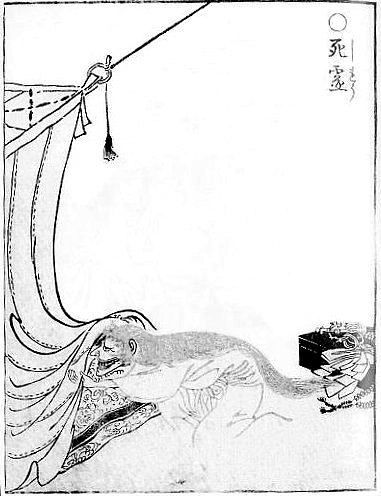
Toriyama Sekien (鳥山石燕), Public domain, via Wikimedia Commons
If we talk about ikiryō, we also have to talk about the opposite, shiryō. I have to be honest here the difference between these spirits and the ones I mention below is not exactly clear to me.
In some sources the 死霊 (shi-ryō) is an onryō that clings to people and curses them. Like ikiryō they are able to possess and torment people, even to death. They are said to stalk people who killed them or even drag them to the “other world”. But, as far as I know on-ryō do that, as well. The one thing that might be different here, is that a shiryō is the personified grudge of a person, like a personified curse, whereas an onryō is an actual person’s soul or spirit, possibly manifesting in a physical form.
✩₊˚.⋆☾⋆⁺₊✧ ☁︎。⋆✧ ✧˚₊‧⋆。˚ ✦₊
怨霊 (On-ryō) — Vengeful Spirit

Onryō literally translates to “Grudge spirit” or “spirit of resentment” and they are heavily featured in Noh and Kabuki plays and art. One of the most popular stories featuring one is Yotsuya Kaidan.
Onryō are people who died with deep resentment, often from betrayal, injustice, or violent death, so they remain in the world to exact revenge on those who wronged them, their descendants or sometimes anyone who’s also there. They are said to cause natural disasters, illness, insanity and even death. To appease them, rituals are held or proper veneration is put in place. There’s also the case of Sugawara no Michizane, the Shinto God of learning, Tenman-Tenjin (that’s his name as a deity), who was deified after becoming an onryō due to being banished because of a wrongful accusation by a rival.
Onryō often reflect concerns about social injustice and also karma. Some people even say the lower a person’s position in life, the stronger they will be as onryō.
The emotional intensity they feel at death and the injustice they experience also makes them tragic figures, which might explain why they are so heavily featured in traditional theatre.
I think I might get into them some more at some point, just because there are so many popular stories featuring them.

✩₊˚.⋆☾⋆⁺₊✧ ☁︎。⋆✧ ✧˚₊‧⋆。˚ ✦₊
悪霊 (Aku-ryō) — Evil Spirit
An akuryō is a general term for an “Evil spirit”. This includes any spirit or supernatural entity that causes harm, regardless of origin or country. Their motives might simply be malice and they’re often associated with illness, possession, or misfortune. A Christian demon would most likely fall under this category.
✩₊˚.⋆☾⋆⁺₊✧ ☁︎。⋆✧ ✧˚₊‧⋆。˚ ✦₊
To sum up any terms that might be confusing (according to this source):
“幽霊” (yūrei) = The phenomenon of a deceased person’s spirit appearing in this world without being able to move on (achieve peace).
“亡霊” (bōrei) = The phenomenon of a deceased person’s soul appearing in human form.
“死霊” (shiryo) = The phenomenon of a deceased person’s grudge or malice attaching to a person or place.
“生霊” (ikiryō) = The phenomenon of the grudge or intense emotion of a living person attaching to another person.
“怨霊” (onryō) = The phenomenon of the soul of a person who died with resentment attaching to land or society.

So, now you know. As I mentioned above, there are many more types of ghosts than mentioned: While categorising them is fun, it can only bring us so far, because folklore is rarely straightforward. I’m sure a lot of these categories are quite blurry, but they still tell us a lot about Japanese attitudes towards death, responsibility and even justice, reflected in stories told about them (and yes, I will get into these some more at some point). I also feel like Japan is a place filled with subtle (and not so subtle) spirituality and when I first went there, I was quite surprised about it. Ghosts seem to be around every corner and so many place have their own stories or urban legends. Discovering these stories, as much as learning about traditions and customs is simply fascinating and I hope I can share this fascination with you!
Thank you for reading!
.₊˚.✦₊૮₍ ´• ˕ • ₎ა ♡‧₊˚ ✩‧₊˚ ✧˚₊‧₊˚ ૮꒰˶ᵔ ᵕ ᵔ˶꒱ა ✩₊˚.
Sources
https://note.com/cute_koala810/n/nd30305f72492
https://religion-in-japan.univie.ac.at/an/Glossar:Sotoba
https://ameblo.jp/rankoufufu/entry-12746253310.html
https://ja.wikipedia.org/wiki/浮遊霊
https://web.archive.org/web/20230206025148/https://kotobank.jp/word/怨霊-42048
https://ja.wikipedia.org/wiki/御霊信仰
https://www.weblio.jp/content/動物霊#:~:text=神道における動物霊の,ができる点である。


